
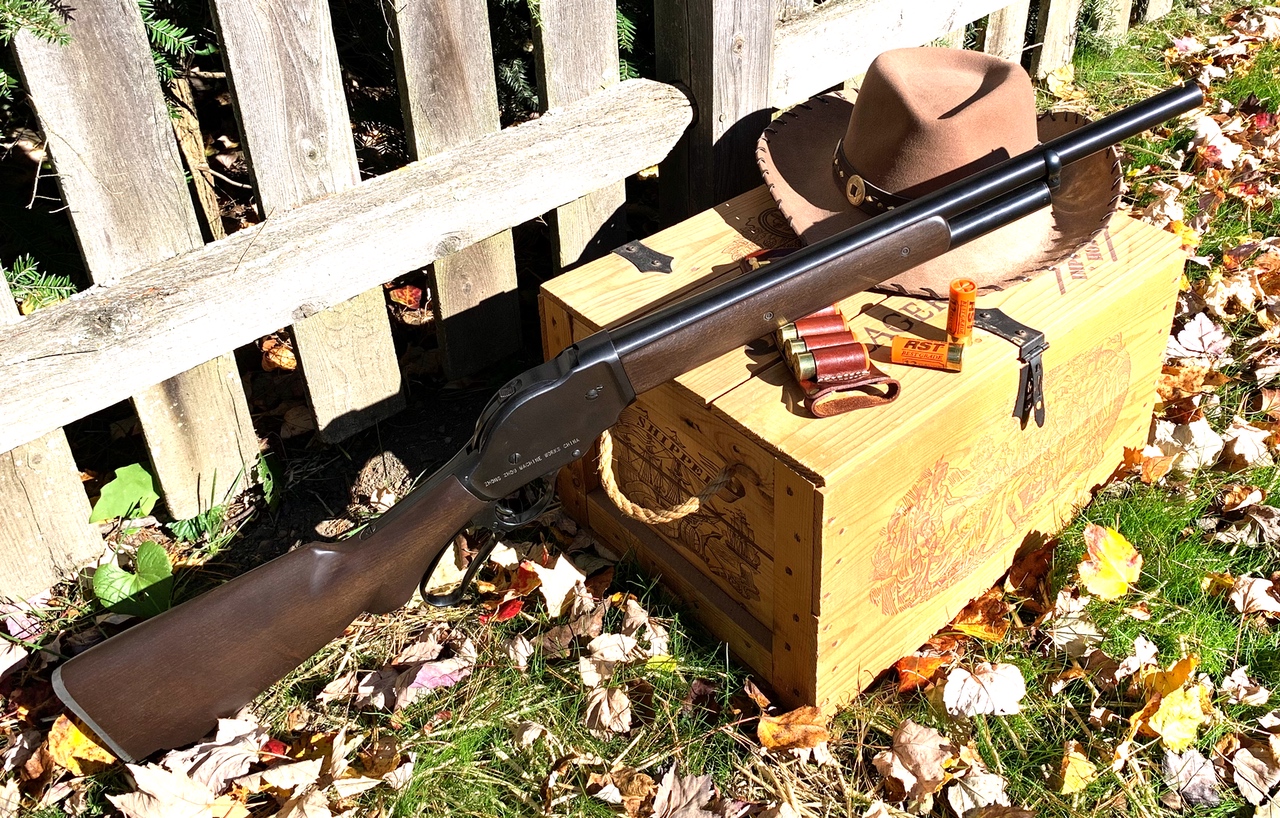
A while back, Century International started importing PW87 shotguns. When I saw they were available, I decided I had to check one out. With an asking price of $250, I could do it sooner than later. The PW87 is a reproduction of one of the original repeating shotguns, the Winchester model 1887. I’m always looking for good examples of different operating systems in firearms, and the 1887’s action is distinctive.
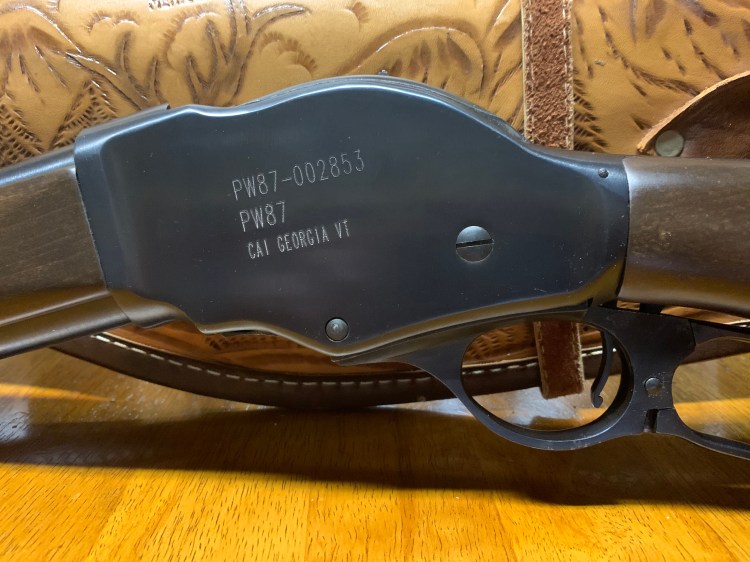
The PW87 is a lever action 12 gauge shotgun. It has a five round tube magazine that hangs under a 19 inch smooth bore barrel, both of which run into a unique humped receiver that houses the shotgun’s rolling block action. This is what makes the PW87 interesting. Instead of using a conventional bolt that moves through the receiver to cycle, the PW87’s action uses a large, one-piece semicircular breech block that rotates back into the receiver when the lever is pulled downward. That’s where the term “rolling block” comes from, and what gives the receiver it’s humped appearance.
My first impressions of the shotgun, right out of the box, were very positive. The shotgun has an overall length of 37.25 inches, making it quick handling in brush or woodlands if used for hunting. The barrel is relatively short, with a permanent Modified choke. That makes it pretty obvious that the PW87 is not a first choice for skeet or trap shooting. But, in hunting situations where you’re flushing ground birds from heavy brush at close range, it just might fit the bill. The PW87 would also be a great fit for Cowboy Action shooting. The shotgun weighs 7.9 pounds, which is a little heavy, but it’s well balanced. I don’t find the weight to be a hinderance, and it works to offset the 12 gauge recoil. The metal on the shotgun is blued, and the finish on my example is deep and even throughout. The stock is of wood, in three pieces: the butt stock, and two hand guards placed on either side of the barrel and magazine tube- leaving the magazine tube partially exposed at the bottom. I found the wood to be tightly in place, with no play at all. It did not loosen during subsequent test firing. The finish of the wood is rich in color, and all three pieces of the stock match. All in all, the PW87 is a nice looking shotgun.
The first thing I did was read the manual and clean the shotgun. The manual is very rudimentary, with illustrations that are not well executed. It took me several times reading it through and referencing the gun before I was ready to begin breaking the shotgun down for cleaning. And it needed cleaning. Being new, the shotgun had gun grease all through the action, and the grease had attracted a lot of grit.
The PW87 loads and ejects through the top of the receiver, and is operated using the lever at the bottom of the receiver. To strip the shotgun, everything comes out of the receiver through the bottom, leaving it hollow. There are two main components to the action: the shell carrier and the breech block. The hammer and mainspring are housed in the breech block. To disassemble the shotgun, first pull down the lever to rotate the breech block back. This exposes the hammer and mainspring under the receiver. Next, loosen the two screws located on both sides of the rear of the receiver. These act as pivots for the shell carrier to move up and down, and loosening them puts play in the mechanism. Now, it gets a little difficult. With needle nose pliers, squeeze the mainspring together and remove it down through the exposed breech block. There is a lot of tension in the spring, so take care. The lever and breech block are held in the action by a pin they rotate around. The pin is held in place by hooks at the end of the mainspring. You have to compress the mainspring enough for the hooks to clear the pin. Positioning the pliers to get the mainspring out the first time is a little awkward. Once you’ve done it, however, it becomes clear how everything in the action is held in place. With the mainspring out, drift out the pin and completely remove the two loosened receiver screws. After that, all the remaining parts can be slid out the bottom of the receiver. Being a shotgun designed in the 1880’s, the PW87’s action resembles clockwork. If you take your time, though, disassembly is relatively straight forward.

Once the shotgun is disassembled, it’s immediately noticeable that the interior finish is not of the same quality as what’s on the outside. The interior parts are cast, and the surfaces where metal moves against metal are mostly unpolished. There are a lot of tool marks on the inside walls of the receiver. What this means is that, at least initially, the action will cycle pretty rough. I dealt with this by working the action a couple hundred times after reassembly. This caused the metal surfaces that move against metal to basically self-polish. Sure, it created wear marks on the finish, but the action smoothed out. The PW87 isn’t a collector grade firearm- it’s a shooter, so I didn’t see a little wear as a problem. Working the action this way, it’s essential to re-clean immediately. Otherwise, the metal particles that were polished off the action will foul the interior of the shotgun.
Reassembly is in reverse order. Once again, the trickiest part is to replace the mainspring and ensure it’s end hooks are set in place to retain it. It’s pretty tight working inside the receiver, and some of the surfaces are recessed. I recommend using a head lamp while you’re working to have adequate light to see what you’re doing. It makes reassembly a lot easier.
With all the preliminaries out of the way, it was time to take the PW87 to the range. My initial range time was disappointing. I started by function firing using 12 gauge 2 3/4 inch club loads. To load, you have to open the action by operating the lever. This also cocks the hammer. Then push the shell carrier down to expose the magazine. Rounds are fed into the magazine by placing the rounds into the receiver through the opening at the top, and then pushing them forward into the tube. Not difficult, but there are some sharp edges inside the receiver, so watch your fingers. Once the magazine is loaded, completely cycle the action once to put the first round in the chamber.
There is no safety on the PW87. There is a half cock position for the hammer, but there is no hammer spur and the hammer sits flush with the back of the breech block. To engage the half cock you have to grasp the hammer with your thumb and, pulling the trigger on a loaded chamber, gently lower the hammer to the half cock position. I recommend not trying it. I practiced with the gun empty, and found the combination of very little surface to grasp on the hammer and a very strong mainspring made putting the gun in half cock very unsafe. Pretty much every time, the hammer would slide from under my thumb and land all the way home. In my opinion, trying to engage the half cock is a recipe for a negligent discharge. That said, I have owned several exposed hammer guns without safeties through the years, and there is nothing inherently unsafe about them. With the PW87, as long as you don’t try to put the gun into half cock, it’s as safe as any of those other guns.
As I said, my initial round of firing was disappointing. I found that rounds fed and fired fine. But, every spent shell would hang up and cause a stovepipe failure to completely eject. I called it a day, and decided to do a little investigating. Through my investigation, I found that all the reviews I read or watched found the PW87 to be mechanically unreliable for the same reason: failure to eject spent rounds. While the extractors on the breech block reliably pull the spent shell from the chamber, it gets hung up on the front of the shell carrier and doesn’t fully eject. I pulled my copy of “Guns Of The Old West” off the shelf and found that when Winchester initially offered the Model 1887, it was chambered for 12 gauge 2 1/2 inch ammunition, not the modern 2 3/4 inch rounds. The PW87 is a reproduction made by Zhong Zhou Machine Works in China, and I think they missed something. Here’s my theory. I believe that when the manufacturer tooled up to reproduce the Model 1887, they chambered the gun for modern 2 3/4 inch ammo, but failed to change the dimensions on the receiver to account for the extra 1/4 inch. So, the gun loads and fires fine. But, when the shell un-crimps as it’s fired, it becomes too long to reliably eject.
To test my theory, I looked around for some 12 gauge 2 1/2 inch shotgun rounds. I finally found RST Shells, a company that specializes in making ammunition for older, fine shotguns. They have a variety of 12 gauge 2 1/2 inch loads on offer, so I ordered a couple boxes of their shells loaded with #10 shot. RST is a great company to do business with. Their customer service is excellent, and I had my shells in a couple of days.

My second trip to the range went much better. I loaded up and fired several five shot strings for function testing. As I thought, the shotgun functioned flawlessly. In each string, all of the rounds ejected and cleared the receiver with no problems. The shotgun proved very pointable and well balanced. I was quickly able to index the front bead sight as I brought the gun to the shoulder and put the muzzle on target. At ten yards, shot patterns were even and centered on where I was aiming. Recoil was very manageable, thanks to the combination of the hard rubber recoil pad on the gun, and the ammunition I was using. The lever worked smoothly, though it kicked out a bit further than I’m used to when it was fully forward. Still, it wasn’t difficult to operate. For someone with a little longer reach than me, they wouldn’t even notice.

So, once the bugs are all worked out, the PW87 is a great shotgun. Yes, you have to run 2 1/2 inch shells through it for it to function reliably, but that’s not a deal breaker. For Cowboy Action shooting, that just adds to authenticity. For a price tag of $250, it’s well worth it , given that original Winchester 1887’s and collector grade reproductions run in the thousands of dollars. If you’re looking for a shotgun with a unique action that’s fun to shoot, you should definitely look at the PW87.
 Tactical & Target