
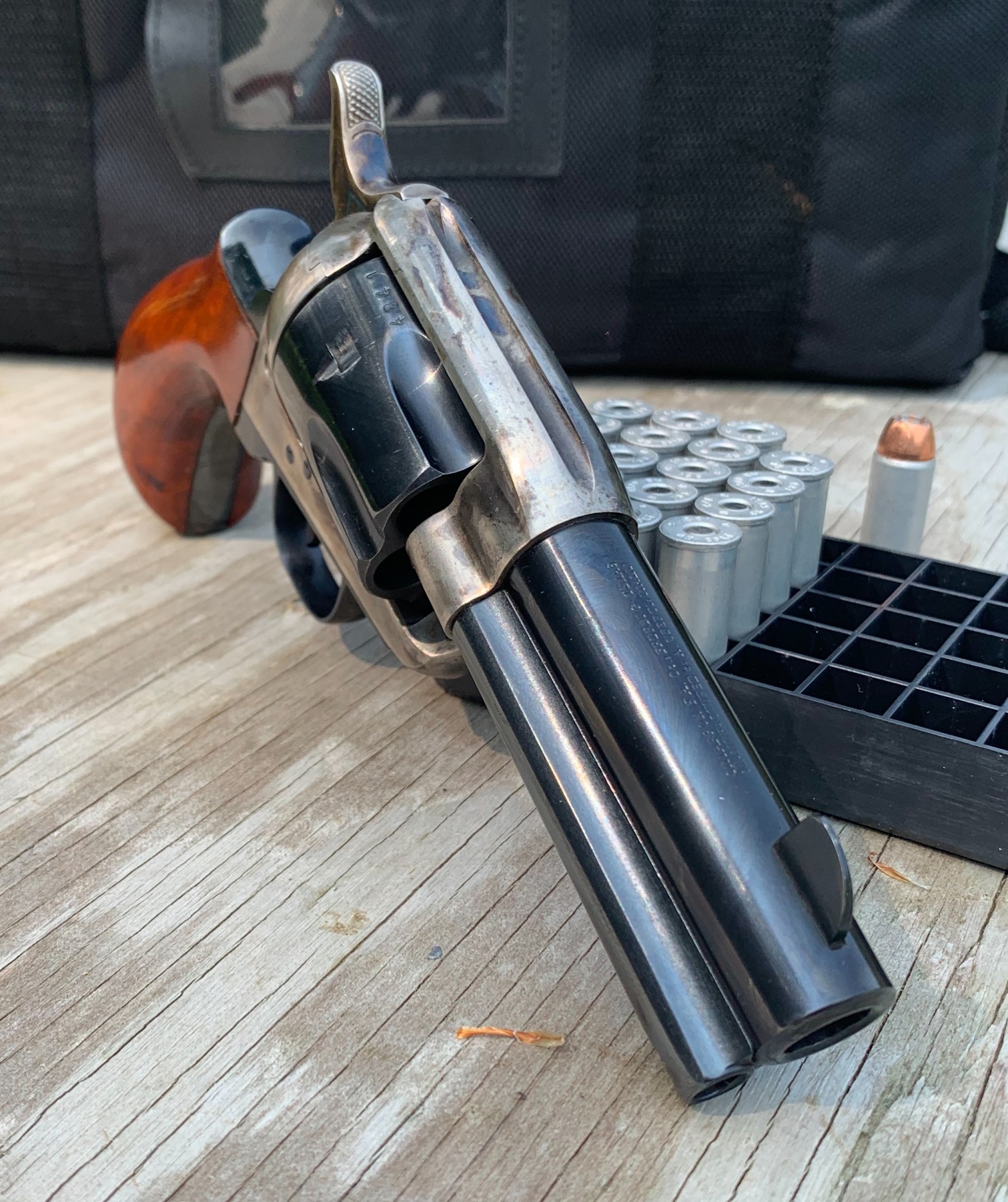
The Colt model 1873 Single Action Army revolver, the famed “Peacemaker”- the iconic gun of the old west. It became the Army’s standard sidearm until well into the 1890’s. It was also hugely popular with western cowboys and lawmen, and later became the staple of Hollywood western movies and TV shows. Because of this, the revolver is probably one of the most identifiable firearms of all time.
While Colt still retains the rights to the names Single Action Army and Peacemaker, the company lost exclusive rights to the handgun’s design a long time ago. That opened up a lucrative reproduction market for gun makers who offer the revolver in a wide array of configurations, calibers, and barrel lengths. This review is of one of the most distinctive: the Cimarron Thunderer.
Cimarron Firearms Co. is the importer and distributor for the Italian gunmaker, Uberti. The two companies have garnered a reputation for attention to detail, and creating highly accurate reproductions of historical firearms of the old west. The Thunderer is distinctive, however, because it’s not a reproduction. While based on the Single Action Army, the combination of features present on the Thunderer are purpose built, and not based on an actual historical handgun.
Most obviously, the barrel length of the Thunderer is 3.5 inches, and incorporates an ejector rod and full length ejector rod housing. Original Colts were offered in a variety of barrel lengths, but when the barrels were under 4 inches, Colt eliminated the ejector rod and housing, leaving only the exposed end of the cylinder base pin under the barrel. The Thunderer’s configuration, to me, is a big improvement. The added ejector not only makes the revolver more functional, and easier to unload, but also maintains the balance of the gun in the hand, making it naturally pointable when bringing it on target.
The grip of the pistol adds to it’s pointability, as well. The Thunderer’s grip is designed by Cimarron, blending features from several other grip styles. First, it incorporates the high hump on the back strap that was originally found on double action revolvers designed closer to the turn of the century. Second, it maintains the cross-section of the original SAA’s “plow handle” grip, allowing the hand a solid purchase in a one-handed hold. Last, the grip is of a “bird’s head” design, often found on smaller pistols and derringers of the era. The rounded heel and pointed toe of the grip, that gives it a distinctive look, also helps to keep the revolver solidly in the hand, and pointed on target. The overall package not only gives the Thunderer a distinctive look, and improves it’s pointability, but works to decrease felt recoil when the gun is fired.
Decreasing felt recoil is a good thing, because the Thunderer is offered in two calibers, .45 Long Colt and the .357 Magnum, both of which can produce heavy recoil. The gun I evaluate here is chambered in .45 LC, simply because it was one of the original Colt chamberings, while the .357 didn’t come along until the 20th century. The .45, to me, retains the Thunderer’s old west feel.
Overall, the Thunderer is a well put together, good looking firearm. The fit and finish is excellent, the features are well thought out, and the combination of a blued barrel, cylinder, and trigger guard with a color case hardened frame, and the distinctive grip, really make the handgun stand out.
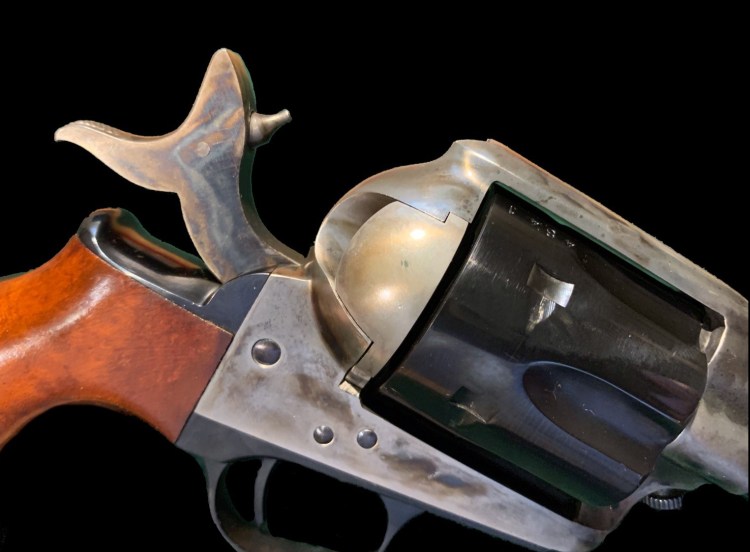
The action of Cimarron’s revolver remains true to the original Colt design. While other single-actions have incorporated internal firing pins, and transfer bar safety features, the Thunderer retains the firing pin affixed to the hammer. Because of this, there are still the audible three clicks as the hammer is drawn back. The first is when the hammer clears the safety position, the second is at half cock, and the third at full cock. The safety position is designed to allow the revolver to be loaded with all six rounds in the cylinder, and carried safely. However, traditionally, the hammer was in the safety position over an empty chamber in the cylinder, and the manual that comes with the Thunderer recommends this as well.
Cimarron did depart from the original Colt design, however, by incorporating another, I think unnecessary, safety feature. The Thunderer uses a “blackpowder” frame, based on early era guns. As such, the cylinder pin is retained by a screw at the front of the frame, instead of a more modern cross pin. Uberti designed the cylinder pin with additional notches along it’s length, and by loosening the retention screw, the cylinder pin can be moved back and held in place to block the hammer at half cock. But when is this safety feature useful? When storing the handgun, it would be unloaded, and wouldn’t need the hammer blocked. When the gun is loaded, at the range, moving the cylinder pin back and forth is just too cumbersome to be useful. By leaving the cylinder pin alone, however, the revolver functions just like every other Single Action Army based handgun.
Range time proved that the Thunderer is a fun gun to shoot. All testing was done standing with a one hand hold. I know, shooting this way won’t demonstrate the gun’s true mechanical accuracy. But hell, it’s a cowboy gun, and cowboy guns are shot with a one hand hold! The Thunderer isn’t for tactical use, and isn’t set up as a target pistol, so why pretend that it is? In any case, the revolver’s simple blade front sight, and notch rear sight incorporated into the top strap of the frame worked fine, and allowed reasonable accuracy.
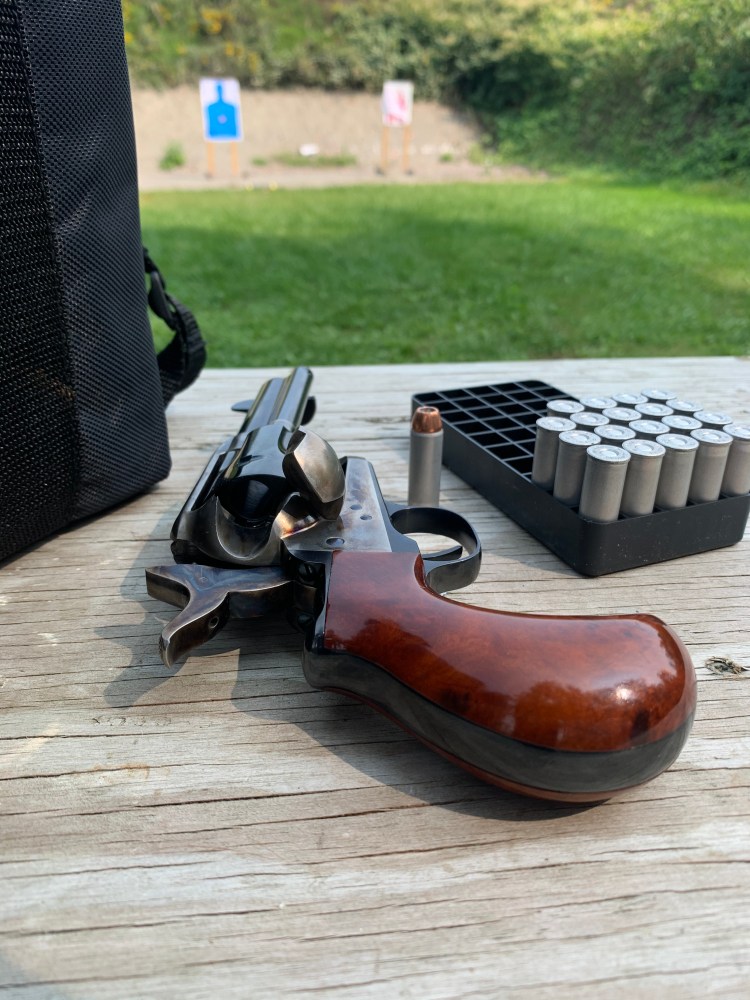
Loading the Thunderer is done by placing the handgun in half-cock, and then opening the loading gate on the right side rear of the frame. Cartridges are then loaded individually into the chambers of the cylinder. Interestingly, many firearms historians believe that Sam Colt was left handed, because his design is best suited for left handed shooters. As a left hander myself, I have always appreciated this, because while my shooting hand retains positive control of the revolver, all the functions of loading and unloading can be done with my off hand. Right handers have to swap hands to load and unload, giving up positive control of the gun while doing so.
Unloading is done in the same way, placing the hammer at half cock and opening the loading gate. Then, align the chambers with the ejector rod and plunge out the spent cases individually. Again, you have to do this left handed, or the cases may hang up on your hand and not fully clear the chamber.

We used CCI aluminum cased jacketed hollow points for our range session. The Thunderer functioned flawlessly. All shooting was done between five and ten yards, dominant hand only. Again, for the rudimentary sights, group size was quite good. Staying with the wild west, rustic theme, group size was measured with the barrel as our measuring stick. All groups, at all ranges, stayed under the length of the barrel, so under 3.5 inches. Because of the balance of the Thunderer in the hand, even when point shooting without looking at the sights, shots stayed clustered around the intended point of impact. The Thunderer’s distinctive grip played a big part in this, because it allows the hand to stay firm while thumbing back the hammer, without needing to readjust to squeeze the trigger. Consistency allows accuracy. It also minimizes muzzle rise between shots, and while thumbing the hammer back, and also helps tame recoil.
Overall, the Thunderer is a great handgun. It has a distinctive look, it’s fun to shoot, and it really does evoke a sense of the old west. If you’re looking for a single action revolver, look no further.
 Tactical & Target