

The Ruger LCR is exactly what it says it is: a lightweight, compact, revolver. Now, if you read about guns for any length of time, you’ll notice that certain topics cycle in and out of fashion with gun writers fairly regularly. One of those topics is whether or not revolvers are effective for self defense. This has a lot to do with what products happen to be coming from the different gun manufacturers at any given time, and the new stuff will always get the press. Regardless of what is currently in vogue, however, the revolver has always been a very effective tool for concealed carry and self-defense. The Ruger LCR is an excellent example.

The LCR is designed from the outset to be comfortable to carry, and concealable. It has an overall weight of 13.5 ounces, which is less than 2 ounces more than a comparable Smith & Wesson scandium J Frame. I find the scandium revolvers to be too light, which makes them easy to carry, but very uncomfortable to shoot, due to heavy recoil. The LCR, while still light, is designed to be much more comfortable to shoot. Ruger did this by mating a monolithic aluminum frame with a polymer fire control unit, housing the trigger and enclosed hammer. That combination is paired with a wrap around Hogue grip that does a great job soaking up recoil all by itself.
As for concealability, the LCR has an overall length of just 6.5 inches, with a barrel length of 1.87 inches. Often, however, the big concern about concealment for revolvers is the width of the cylinder. The LCR has a five round cylinder, giving the handgun a width of 1.28 inches. For comparison, a Smith & Wesson J Frame has a width of 1.3 inches. But, the big comparison is with a Glock 17 semi-auto, which has a width of 1.26 inches. So, the LCR has a concealable imprint that is very competitive with other defensive handguns.
The LCR is also durable. While the fire control unit is polymer, the frame is made from one piece of aluminum, with no side plate, which makes it very sturdy. The cylinder is coated stainless steel, and the barrel is a stainless steel insert in the aluminum frame. The LCR is built to last and resist wear over a lifetime of shooting. The coat on the cylinder is also made to reduce shine, giving the revolver an overall matte black finish.
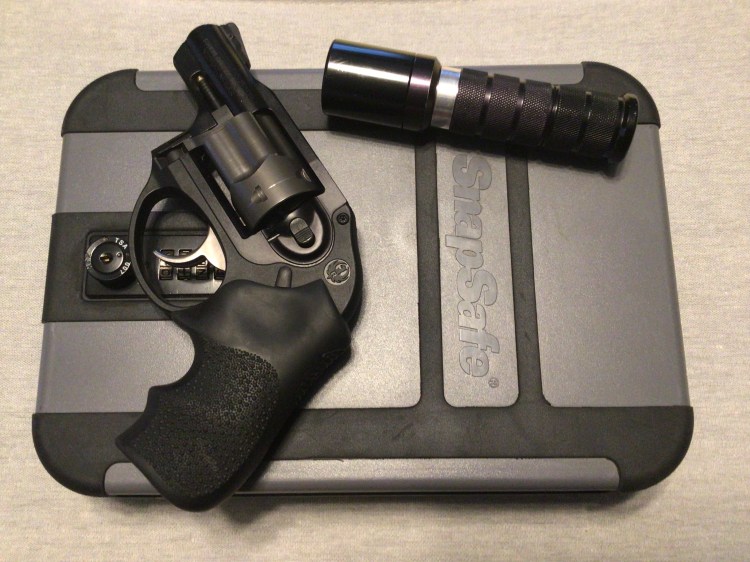
The LCR has an ammunition capacity of five rounds. This is where the claims of revolvers not being adequate for self-defense usually start. Firepower. Detractors will most often point out the fact that a semi-auto pistol can have a higher capacity magazine. The Glock I mentioned before uses a 17 round magazine. But, here’s the thing about firepower. It’s necessary for Police looking for a duty weapon, or military personnel. Because they, due to their job, are required to place themselves in high threat situations. Be it a hight threat warrant service, a midnight traffic stop With multiple people in the car, or responding to a domestic dispute with reports of one or more armed individuals. But, the individual armed for self-defense has the obligation to avoid high threat situations. The use of force is the last resort. Requirements for a duty weapon and an in extremis self-defense tool are not the same. That’s why armed professionals may still carry a concealable revolver as a backup. So, the average armed citizen shouldn’t be looking for a weapon to use in a firefight, where you have to shoot, move, and communicate. The armed citizen needs a self-defense tool to get out of a lethal situation that’s up close and fast, when there’s no other option possible. And remember, where police and military have sanction to use force, civilians don’t. You are legally responsible for every round you fire. There is no shooting to suppress, where high volumes of fire are needed, only shooting to hit- and every shot has to. While this article isn’t intended as training, and it’s just my opinion, even if some may call me a Fudd, I’ll stand by it.

The LCR is available in a variety of calibers. The one I tested was chambered in .38+P. Other chamberings include .38 Special, .357 Magnum, .327 Federal, 9mm and .22 rimfire. On the range, I found the recoil of the +P rounds to be very manageable. I used Blazer and Winchester 125 grain self-defense ammunition. Both the brass cases of the Winchester ammo, and the aluminum cases of the Blazer ammo ejected cleanly out of the cylinder, allowing for rapid reloading with an HKS speed loader. I also like that Ruger uses a push button cylinder catch, which I find much easier to manipulate left handed.
The sights of the LCR are what you would expect from a short barreled revolver, a rear notch in the top strap of the frame, and a blade front sight. While rudimentary, the pistol proved accurate during rapid fire strings between 5 feet and 10 yards. All rounds landed within a six inch target, even during point shooting. The Hogue grip gives the revolver great pointability.
Because of it’s enclosed hammer, the LCR has a DAO trigger. The pull weight is a consistently smooth 7.5 pounds. For revolver purists, Ruger offers the LCRx, which is a model with an exposed hammer with spur allowing a SA/DA trigger pull. The LCRx also offers different barrel lengths and sight options. I prefer the enclosed hammer for every-day carry since there is no hammer spur that may snag on clothing.

So, if you’re looking for a lightweight, compact, and concealable handgun for everyday carry, the Ruger LCR is a great choice. It’s reliable, uncomplicated, and it packs a punch. At a starting MSRP of $739, it’s also a great value.
 Tactical & Target