The Holidays are here again, and once again you may find yourself scrambling to find the right gift for the firearms enthusiast in your life. Now, a gift doesn’t always have to be ammunition or a rifle case. Though I don’t know any shooters who would be disappointed with either of those. But, for the non-shooter looking for a gift, the question always is what kind of ammo, or what kind of rifle case. And, as we all know, that’s a rabbit hole many people aren’t willing to go down simply searching for a Holiday gift. But, there are a bunch of shooting adjacent gifts that are fun and usable, and easily accessible to non-shooters. The Bolt Action Pen from Turner Mastercraft is one of these.
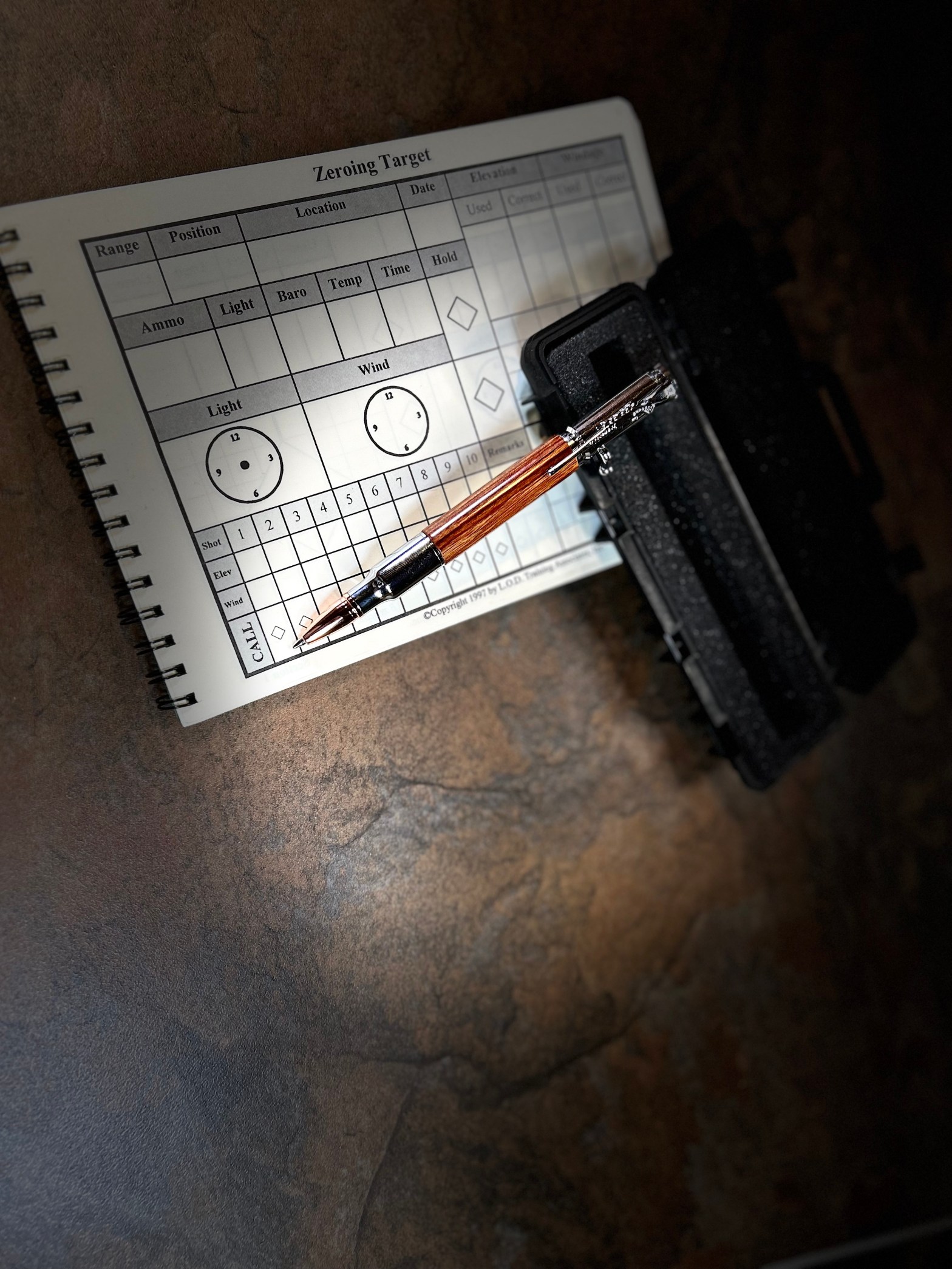
Now, being a writer, I’ll admit I’m partial to pens. Some are tools, and some are works of art. The Bolt Action Pen is both of these. Artistically, the pen is beautiful. The front metal is shaped to resemble a rifle cartridge with a copper nose resembling a bullet, that unscrews to allow replacement of the ink cartridge. The rear metal is shaped like a rimless case head, complete with a round insert resembling a primer, and a head stamp. The rear metal also houses the action of the pen. No push button here. Instead, the writing point is actuated by a sliding bolt handle that can lock in the writing position. To retract the ball point, you have to unlock and slide back the bolt handle just like on a bolt action rifle. I think that’s pretty slick, and I think once you’ve tried it, you’ll think that too. The metal finishes off with a pocket clip shaped like a scoped hunting rifle.
The Bolt Action Pen has a unique pocket clip shaped like a hunting rifle.
In between the metal ends is a gorgeous piece of hand turned wood that grabs your attention. The wood is thin layers of Vermont Birch that have been laminated together, and dyed in a variety of colors. The wood is then hand turned on a lathe by master pen maker Pete Turner, and given an epoxy finish for durability. The final product is a thing of beauty that will last a lifetime. The metal parts even have a lifetime guarantee.
As a tool, the Bolt Action Pen is an outstanding writing instrument. I write a lot long hand, and I have found this pen to be one of the most comfortable pens I’ve ever used. The barrel diameter is just right for the hand. The pen is also very well balanced, with the weight heavier at the rear so it rests on the web of the thumb and takes pressure off the fingers. Also, being left handed, I have no problem manipulating the action of the pen. It may sound strange, but not all pens are ambidextrous. This one is. Overall, I can write for a long time with this pen without any cramping or hand fatigue. As you no doubt know by now, I think this is a great pen.
The other nice thing about the Bolt Action Pen is that you don’t have to worry about running out of ink. It takes standard Parker ink or gel refills that you can pretty much get anywhere.
Lastly, and what initially caught my eye, is that the pen is offered with a locking foam-lined case that resembles a Pelican gun case. It makes for a unique pen holder, and has taken a prominent place on my desk.
The Bolt Action Pen has the option of coming packed in a mini rifle case.
The one snag you may run into looking for a Turner Mastercraft pen is actually the result of COVID. Turner Matercraft has been a fixture at the Eastern States Exposition in Massachusetts for years, and that’s where I found their pens. These pens are art, and hand made. But COVID had a really bad impact on small, artisan operations by shutting down all the fairs and art shows. And, it’s taking a long time for that community to recover. In that atmosphere, Turner Mastercraft has gone to an abbreviated show schedule, and has stopped mail order. But, the good news is that they post their show schedule on their website: turnermastercraft.com. If you’re in the area of one of their shows, I highly recommend you search them out. I think the quality of their pens is as good, or better, than Mont Blanc, and their prices are much more affordable. They also make a variety of pen types, not just the Bolt Action Pen. So, if you’re looking for a unique gift for a shooter, that’s heirloom quality, the Turner Mastercraft Bolt Action Pen fits the bill.
The Ruger LCR is exactly what it says it is: a lightweight, compact, revolver. Now, if you read about guns for any length of time, you’ll notice that certain topics cycle in and out of fashion with gun writers fairly regularly. One of those topics is whether or not revolvers are effective for self defense. This has a lot to do with what products happen to be coming from the different gun manufacturers at any given time, and the new stuff will always get the press. Regardless of what is currently in vogue, however, the revolver has always been a very effective tool for concealed carry and self-defense. The Ruger LCR is an excellent example.
The LCR is comfortable to carry in an inside the waistband holster
The LCR is designed from the outset to be comfortable to carry, and concealable. It has an overall weight of 13.5 ounces, which is less than 2 ounces more than a comparable Smith & Wesson scandium J Frame. I find the scandium revolvers to be too light, which makes them easy to carry, but very uncomfortable to shoot, due to heavy recoil. The LCR, while still light, is designed to be much more comfortable to shoot. Ruger did this by mating a monolithic aluminum frame with a polymer fire control unit, housing the trigger and enclosed hammer. That combination is paired with a wrap around Hogue grip that does a great job soaking up recoil all by itself.
As for concealability, the LCR has an overall length of just 6.5 inches, with a barrel length of 1.87 inches. Often, however, the big concern about concealment for revolvers is the width of the cylinder. The LCR has a five round cylinder, giving the handgun a width of 1.28 inches. For comparison, a Smith & Wesson J Frame has a width of 1.3 inches. But, the big comparison is with a Glock 17 semi-auto, which has a width of 1.26 inches. So, the LCR has a concealable imprint that is very competitive with other defensive handguns.
The LCR is also durable. While the fire control unit is polymer, the frame is made from one piece of aluminum, with no side plate, which makes it very sturdy. The cylinder is coated stainless steel, and the barrel is a stainless steel insert in the aluminum frame. The LCR is built to last and resist wear over a lifetime of shooting. The coat on the cylinder is also made to reduce shine, giving the revolver an overall matte black finish.
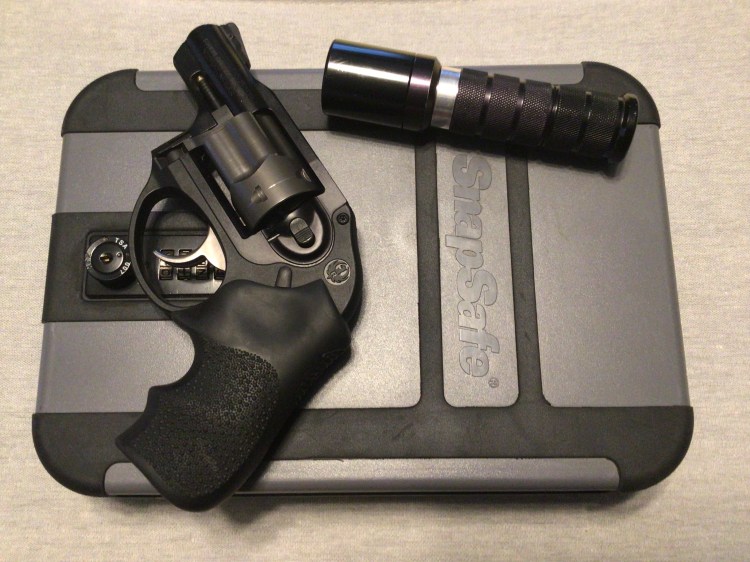
The LCR fits just right in a Hornady SnapSafe when traveling
The LCR has an ammunition capacity of five rounds. This is where the claims of revolvers not being adequate for self-defense usually start. Firepower. Detractors will most often point out the fact that a semi-auto pistol can have a higher capacity magazine. The Glock I mentioned before uses a 17 round magazine. But, here’s the thing about firepower. It’s necessary for Police looking for a duty weapon, or military personnel. Because they, due to their job, are required to place themselves in high threat situations. Be it a hight threat warrant service, a midnight traffic stop With multiple people in the car, or responding to a domestic dispute with reports of one or more armed individuals. But, the individual armed for self-defense has the obligation to avoid high threat situations. The use of force is the last resort. Requirements for a duty weapon and an in extremis self-defense tool are not the same. That’s why armed professionals may still carry a concealable revolver as a backup. So, the average armed citizen shouldn’t be looking for a weapon to use in a firefight, where you have to shoot, move, and communicate. The armed citizen needs a self-defense tool to get out of a lethal situation that’s up close and fast, when there’s no other option possible. And remember, where police and military have sanction to use force, civilians don’t. You are legally responsible for every round you fire. There is no shooting to suppress, where high volumes of fire are needed, only shooting to hit- and every shot has to. While this article isn’t intended as training, and it’s just my opinion, even if some may call me a Fudd, I’ll stand by it.
The LCR functions reliably with all types of ammunition
The LCR is available in a variety of calibers. The one I tested was chambered in .38+P. Other chamberings include .38 Special, .357 Magnum, .327 Federal, 9mm and .22 rimfire. On the range, I found the recoil of the +P rounds to be very manageable. I used Blazer and Winchester 125 grain self-defense ammunition. Both the brass cases of the Winchester ammo, and the aluminum cases of the Blazer ammo ejected cleanly out of the cylinder, allowing for rapid reloading with an HKS speed loader. I also like that Ruger uses a push button cylinder catch, which I find much easier to manipulate left handed.
The sights of the LCR are what you would expect from a short barreled revolver, a rear notch in the top strap of the frame, and a blade front sight. While rudimentary, the pistol proved accurate during rapid fire strings between 5 feet and 10 yards. All rounds landed within a six inch target, even during point shooting. The Hogue grip gives the revolver great pointability.
Because of it’s enclosed hammer, the LCR has a DAO trigger. The pull weight is a consistently smooth 7.5 pounds. For revolver purists, Ruger offers the LCRx, which is a model with an exposed hammer with spur allowing a SA/DA trigger pull. The LCRx also offers different barrel lengths and sight options. I prefer the enclosed hammer for every-day carry since there is no hammer spur that may snag on clothing.
The LCR is very unobtrusive when carrying concealed
So, if you’re looking for a lightweight, compact, and concealable handgun for everyday carry, the Ruger LCR is a great choice. It’s reliable, uncomplicated, and it packs a punch. At a starting MSRP of $739, it’s also a great value.
Sometimes you have to challenge yourself. For that reason, I’ve been looking for a different type of training course. I found it in Task Force SIG. The Sig Sauer Academy offers Task Force SIG as a one day team building/ leadership course with a firearms component. Sig’s promotional video states that their course is modeled on Special Forces selection, and is heavy on people carrying rucks, moving through wooded terrain, and running shooting drills. It sucked me right in.
Now, I went into this course with no illusions. Actual Special Forces selection is something like fourteen days long, and extremely physically demanding. This course is not that. And, anyway, I’m a middle aged man who doesn’t do a lot of formal physical training. Task Force SIG is an opportunity to do some applied problem solving in a team environment, while being subjected to mild physical and mental stress. Roughly half the course is range time, running drills while under the same physical and mental stress. So, a shooting course run in a challenging environment, combined with carrying a ruck and working as part of a team. It’s a unique course you wouldn’t expect to see at a civilian shooting school. I decided I needed to check it out.
The Sig Sauer Academy uses online registration. Make sure to register well in advance. Because, part of the registration process is a background check to ensure you are legally able to attend the course. The check could take a couple of weeks to come back. This is a smart move on their part, even if it hinders last minute registrations. Years ago, the Smith & Wesson Academy was forced to close because individuals used their facility who shouldn’t have. Sig is ensuring they won’t have that problem, so they can continue to provide world class training to civilians for years to come.
When You arrive at the Sig Academy in New Hampshire, students check in at the new Experience Center that just opened earlier this year. The new building houses an expanded pro shop, the Sig Sauer Museum, and New Hampshire’s only Black Rifle Coffee franchise. The Experience Center fronts one of this country’s premier shooting facilities. In my estimation, it’s the most extensive facility open to civilians. Once you check in, you’re directed to your classroom.
Task Force SIG is set up in phases. The first phase takes place in a classroom environment. This is where the students meet each other and the instructors, discuss the purpose of the course, and are introduced to the traits and characteristics of effective leadership. Colin, the lead instructor and developer of the course, and Zack, his co-instructor, are both veterans of Army Special Forces. What they teach isn’t theoretical, it comes from actual experience, and it shows. What students learn in the classroom, they apply in the rest of the course.
The Task Force SIG reading list. Creases are from being folded up in the author’s cargo pocket.
Next, the course moves outside. This phase consists of a series of team challenges as students move along Sig’s Leadership Reaction Course. Different members of the team are given a leadership role for each task, which must be completed under a time limit. Students also carry weighted ALICE packs, to add physical stress. This gives the students the opportunity to experience group dynamics, and manage different personalities while in a leadership role. For many, this, by itself, is a unique opportunity to experience something outside the norm of usual training.
After a short lunch break, the class moves to the range. This is what I was most anticipating when I signed up. It didn’t disappoint. Students are issued Sig MPX 9mm carbines topped with Sig Romeo red dot sights, and three magazines each. Drills start at the five yard line, where everyone learns to load, unload, and manipulate the rifle safely. Students are also shown how to offset for the difference between point of aim and point of impact at short distances. Then begins a series of timed team drills run between ten and fifty yards shooting at steel silhouettes. The drills emphasize team improvement as students are challenged to find ways to run the drills faster with each repetition. After that, students run competitive relay drills. However, they have to run down the range, up a couple flights of stairs and back again before the relays begin. Moving and shooting while under induced physical strain gives students a much better understanding of the realities of shooting under stress than shooting only from a static firing line.
Two things stood out to me from our range time. First, our instructors ran the range with consummate professionalism. In a very short time, they took a group of students with widely varied firearms experience, familiarized them with the MPX, and successfully had them running shoot and move drills from a series of fluid firing lines. All the while ensuring safe range conditions while simultaneously putting the students under physical and mental strain. Their relaxed confidence while maintaining positive control of the range set everyone up for success. Second, the Sig MPX is a very intuitive shooting platform. The controls are set up so that anyone familiar with the AR-15 will be able to manipulate the MPX right away, with the bonus that the selector switch is ambidextrous. The carbine’s ergonomics are spot on, making it very pointable, easy to get consistent stock weld from the low ready, and fast to get rounds on target with negligible recoil. Combined with the red dot, it is also very accurate. Overall, I’m very impressed with the MPX.
The class then moves to the 100 yard line, hands in their carbines, and transitions to suppressed Sig Cross rifles chambered in 6.5 Creedmore, and topped with Sig’s excellent 3×18 variable power BDX scope. After firing to again familiarize with the new weapon, students are broken up into shooter/ spotter pairs. Targets made up of varied colors and shapes are placed on the target stands, and the spotters are told where the shooters should place their rounds. This is designed to highlight communicating effectively, as the spotters then have to verbally describe the correct point of aim to the shooters. It was a great exercise. It showed just how easy it is to miscommunicate information, and why accurately communicating is important. The Cross rifles were great. The 6.5 chambering had very manageable recoil, and the BDX scopes provided a very clear and bright target picture.
With the range portion of the class complete, the last phase consists of running a military style obstacle course as a team. Sig’s obstacle course is great. I haven’t run an obstacle course like it since about 1990. Even if I did forget how to correctly negotiate a couple of the obstacles, it was fun. Honestly, if I lived in New Hampshire, I’d get one of the new memberships Sig offers so I could run the obstacle course once a week. What a great way to maintain functional fitness!
And that’s the class. So, what do I think? A couple of things. First, the MPX, Cross rifle, and BDX scope all deserve reviews of their own. I really enjoyed working with them. That’s something to work on for the future. Second, I think a class like this has a lot of value. You don’t usually see something like Task Force SIG outside of the military. It’s similar to the Small Unit Leadership Evaluation exercises at Marine Corps Officer Candidate School, and actually modeled on Special Forces selection. However, as I mentioned previously, those courses are weeks long, and there’s always the stress of failing a task and being dropped. In the civilian setting of a one day course, that stress is absent. So, if a student fails a task, it’s much easier to discuss why and focus on improvement. In fact, that’s really the theme of the course. Task Force SIG really is an opportunity to get a snapshot of your strengths and weaknesses in a challenging environment while working with others, and get positive feedback on possible ways to improve. I highly recommend it. It’s not a class Sig runs all the time, so you have to watch for it on their training schedule. But if you get the opportunity to go, it’s worth it. My only critique is that I wish Sig offered the Task Force SIG hoodie for sale at the Experience Center. If they did, I would have bought one in a heart beat!
I like this offering from Smith & Wesson very much. In the next few paragraphs I’ll explain why. But first, I want to address some of the comments I’ve seen in other reviews of this pistol that I think are counter-productive. I’ve seen this pistol referred to as a “granny gun”, or a “girl gun” a number of times. Mostly, this is because it’s chambered for the .380 ACP round. Likewise, it’s often because the slide is designed to be manipulated with less effort than other automatic pistols of the same type. These criticisms are nonsense. Being derogatory about a pistol because it is somehow “feminine”, says nothing about how effective it is as a self-defense tool, and just serves to present the firearms community in a bad light. To me, being able to place rounds on target rapidly, accurately, and consistently is far more important than caliber. A pistol that facilitates rapid, accurate, and consistent shot placement is doing it’s job. The Performance Center 380 Shield EZ does it’s job very well.
The first impression I had of this pistol was asking myself why a striker fired pistol has a thumb and grip safety. I quickly discovered that the answer is that the pistol isn’t striker fired at all, but is actually an internal hammer single action. This is just one of the factors that distinguish this pistol from others in the M&P lineup. The single action design gives the pistol a crisp, consistent trigger press, while the arrangement of the safety features is based on the classic Browning design made familiar by the Colt 1911. For carry, the internal hammer eliminates the possibility of the hammer being snagged on clothing as the pistol is drawn from the holster. At an unloaded weight of just 18.5 ounces, the pistol is light weight, compact, and lends itself to concealment.
Coming from Smith & Wesson’s Performance Center, the pistol has a number of value-added enhancements. From top to bottom, the first enhanced feature is the combination fiber-optic/ tritium sights. They are very good. The combination ensures a bright sight picture in both daylight and low light environments. I found the sights easy to acquire quickly from the draw, and the tritium inserts ensure the sights will stay bright for years.
Next, the stainless steel slide is black anodized to eliminate shine and protect it from wear and corrosion. The forward portion of the slide is also skeletonized to reduce the pistol’s overall weight. As with other EZ’s, the slide is designed to decrease the effort necessary to rack a round into the chamber, while maintaining the pistol’s reliability. There are nice looking scalloped grooves machined into the front and rear of the slide to ensure a solid grip when chambering a round or locking the slide to the rear. Another nice design feature is the addition of two rounded ears at the rear of the slide that make it very easy to do a press check to ensure that a chambered round is actually hooked onto the extractor. The slide also incorporates a tactile loaded chamber indicator.
Moving downward, the barrel of the pistol is four centimeters longer than the standard 380 EZ to make space for porting at the muzzle. The porting is designed to decrease muzzle rise, allowing faster follow-up shots. As with the slide, the barrel is also black anodized stainless steel.
One of the signature improvements of the Performance Center 380 EZ over other M&P models is the trigger. The trigger is one piece, flat faced, and made of anodized aluminum. I have never liked the pinned, two piece, polymer triggers on M&P pistols. I have found them to feel wobbly and mushy. I have also found that the two piece trigger can pinch the trigger finger. The Performance Center 380 EZ’s trigger does away with all of that. It has a crisp break, and a clean reset. The flat face of the trigger allows for better contact with the trigger finger. The overall effect is a better feel of the trigger, and excellent practical accuracy.
The frame of the pistol is made of black, textured polymer. It is very solid, ensuring there is no flex from grip pressure that might pinch the magazine well. The front of the frame has a molded in rail to allow the addition of a light or laser module. The magazine release is reversible, to set it up for left handed shooters, and the thumb safety is also ambidextrous. The thumb safety can also remain engaged when the slide is locked to the rear. The grip safety is anodized aluminum, and designed to engage comfortably with the web of the hand.
The pistol accepts eight round, single column, metal magazines that seat positively into the magazine well, and consistently drop free when the magazine release is pressed. The magazines have side buttons under the high visibility follower, to allow the follower to be easily lowered during loading. Being able to lower the follower makes loading magazines a lot easier.
The Performance Center package includes two magazines and a cleaning kit
The Performance Center box includes the pistol, two magazines, an easily understandable and illustrated user manual, a high visibility chamber flag, and a Performance Center cleaning kit. The kit provides a cleaning rod, several eyelet and jig attachments, brushes, and cleaning patches. A chamber lock is also included to ensure safe storage.
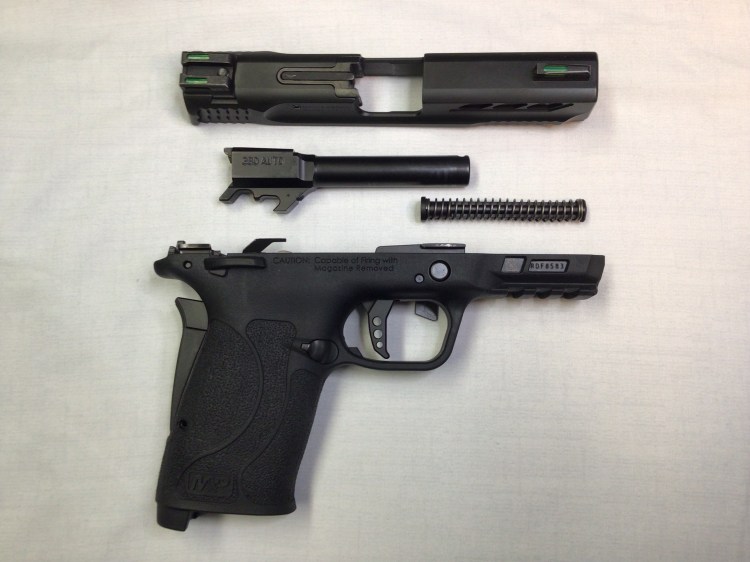
Disassembly of the pistol is very straight forward and uncomplicated. Start by removing the magazine and locking the slide to the rear. Make a visual and tactile inspection of the chamber to ensure the pistol is clear. With the slide locked back, the take down notch in the slide automatically aligns with the take down lever on the frame. Rotate the lever downward, unlock the slide and bring it forward off the frame. Once the slide is separated, press the recoil spring forward and remove it from the slide. With the recoil spring removed, the barrel can then be lifted out of the slide as well. That’s it. Reassemble in reverse order, taking care to align the slide with the frame rails, and lining up the frame mounted ejector with the cutout for it on the rear of the slide.
The pistol breaks down easily for cleaning
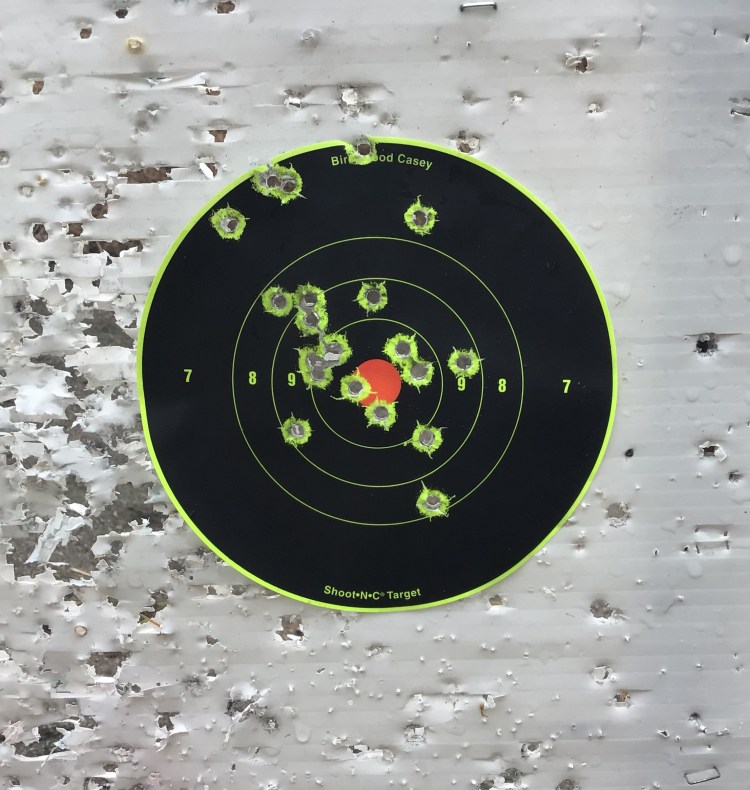
On the range, this pistol is a pleasure to shoot. I tested it’s function with a variety of full metal jacket and hollow point ammunition, and there were no malfunctions. For practical accuracy testing, I fired five round, rapid fire groups at five, seven, and ten yards using a six inch diameter target. All rounds landed on target. The only hiccup was my first ten yard group. It landed high. While all rounds were on target, the group was still higher than the rest. One of the problems with reviewing a variety of different handguns is that you have to be very aware of your grip. I found that I had changed my grip slightly because of my relative unfamiliarity with the pistol. Once I corrected my grip, the second group at ten yards moved back to center.
During accuracy testing, all rounds grouped within a six inch circle.
Being chambered in .380 ACP, the pistol’s recoil was very manageable. Muzzle rise was negligible, allowing for very fast rapid fire strings. Spent cases were positively ejected, and all the cases landed in the same general area, indicating that the pistol was operating very consistently shot to shot.
Overall, Smith & Wesson’s Performance Center enhanced M&P 380 Shield EZ is a great pistol. It is light weight, compact, has excellent practical accuracy, and it’s reliable. It has very positive safety features, and is very well thought out. The pistol’s size lends itself to concealability, making it appropriate for defensive carry, as well as for the range. The Performance Center enhancements don’t price it out of the market either. At an MSRP of $564, it not only performs, It’s affordable.
The holidays are upon us once again. If you have a significant other that enjoys shooting, you’re lucky. Not only do you share an interest and activity, there is also an array of interesting shooting themed products suitable as gifts. Whether it’s Christmas, an anniversary, or a birthday, there’s a whole bunch of possibilities out there. One of the best I’ve found is the subject of this article- the Bullet Bouquet.
The Bullet Bouquet is a gift that will last a lifetime
Flowers have long been a standby gift. But the problem with flowers is that they ultimately wilt. Not so with the Bullet Bouquet. It’s flowers are actually hollow point bullets fired into medium that allows them to expand and open up into their distinctive petal pattern. The bullets are then soldered onto metal ”stalks”, and anchored into a pot or vase, depending on your order. The flowers never wilt, and makes a gift that will last a lifetime.
Each bouquet is customizable too. You can choose the number of bullet “flowers” in your bouquet, and their caliber (9mm, .40, or .45). There are choices for different colored glass vases or flower pots that can be laser engraved. The vases are filled with glass beads that can be ordered in a variety of colors. The bouquets can also be ordered gift wrapped.
The bouquets can be ordered with a variety of different colored glass vases and filler beads
The company that offers the Bullet Bouquet is a pleasure to do business with. It’s family owned, and provides excellent customer service. When I ordered mine, I received an email order confirmation almost immediately, and my bouquet shipped the same day. UPS delivered it in two days, and it was very well packaged and undamaged. Overall, it was a great buying experience, and my gift was a big hit.
So, if you’re looking for a unique gift, visit bulletbouquets.com and check them out. Bouquets start around $45 plus shipping. You won’t be disappointed.
The Colt model 1873 Single Action Army revolver, the famed “Peacemaker”- the iconic gun of the old west. It became the Army’s standard sidearm until well into the 1890’s. It was also hugely popular with western cowboys and lawmen, and later became the staple of Hollywood western movies and TV shows. Because of this, the revolver is probably one of the most identifiable firearms of all time.
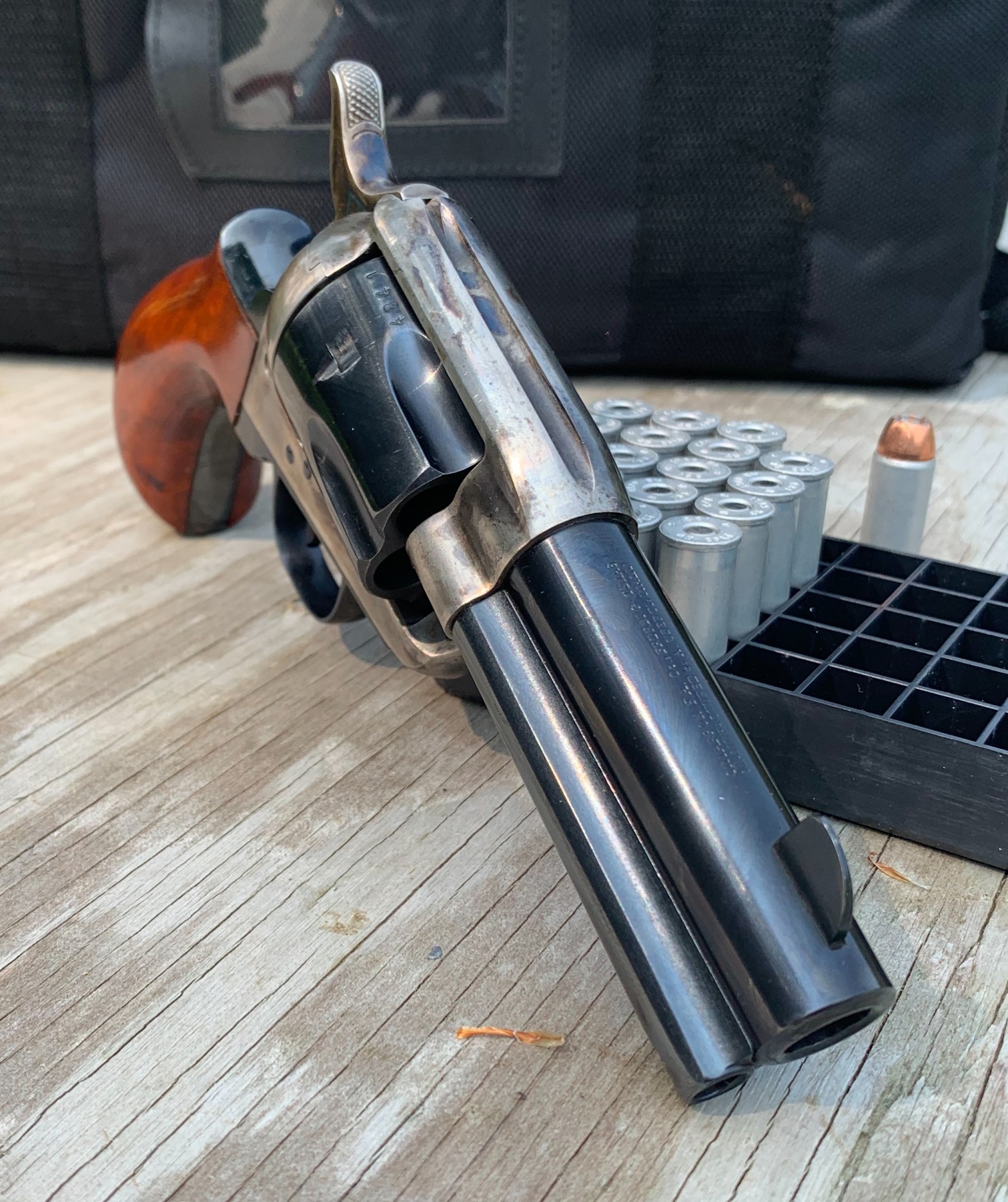
While Colt still retains the rights to the names Single Action Army and Peacemaker, the company lost exclusive rights to the handgun’s design a long time ago. That opened up a lucrative reproduction market for gun makers who offer the revolver in a wide array of configurations, calibers, and barrel lengths. This review is of one of the most distinctive: the Cimarron Thunderer.
Cimarron Firearms Co. is the importer and distributor for the Italian gunmaker, Uberti. The two companies have garnered a reputation for attention to detail, and creating highly accurate reproductions of historical firearms of the old west. The Thunderer is distinctive, however, because it’s not a reproduction. While based on the Single Action Army, the combination of features present on the Thunderer are purpose built, and not based on an actual historical handgun.
Most obviously, the barrel length of the Thunderer is 3.5 inches, and incorporates an ejector rod and full length ejector rod housing. Original Colts were offered in a variety of barrel lengths, but when the barrels were under 4 inches, Colt eliminated the ejector rod and housing, leaving only the exposed end of the cylinder base pin under the barrel. The Thunderer’s configuration, to me, is a big improvement. The added ejector not only makes the revolver more functional, and easier to unload, but also maintains the balance of the gun in the hand, making it naturally pointable when bringing it on target.
The grip of the pistol adds to it’s pointability, as well. The Thunderer’s grip is designed by Cimarron, blending features from several other grip styles. First, it incorporates the high hump on the back strap that was originally found on double action revolvers designed closer to the turn of the century. Second, it maintains the cross-section of the original SAA’s “plow handle” grip, allowing the hand a solid purchase in a one-handed hold. Last, the grip is of a “bird’s head” design, often found on smaller pistols and derringers of the era. The rounded heel and pointed toe of the grip, that gives it a distinctive look, also helps to keep the revolver solidly in the hand, and pointed on target. The overall package not only gives the Thunderer a distinctive look, and improves it’s pointability, but works to decrease felt recoil when the gun is fired.
Decreasing felt recoil is a good thing, because the Thunderer is offered in two calibers, .45 Long Colt and the .357 Magnum, both of which can produce heavy recoil. The gun I evaluate here is chambered in .45 LC, simply because it was one of the original Colt chamberings, while the .357 didn’t come along until the 20th century. The .45, to me, retains the Thunderer’s old west feel.
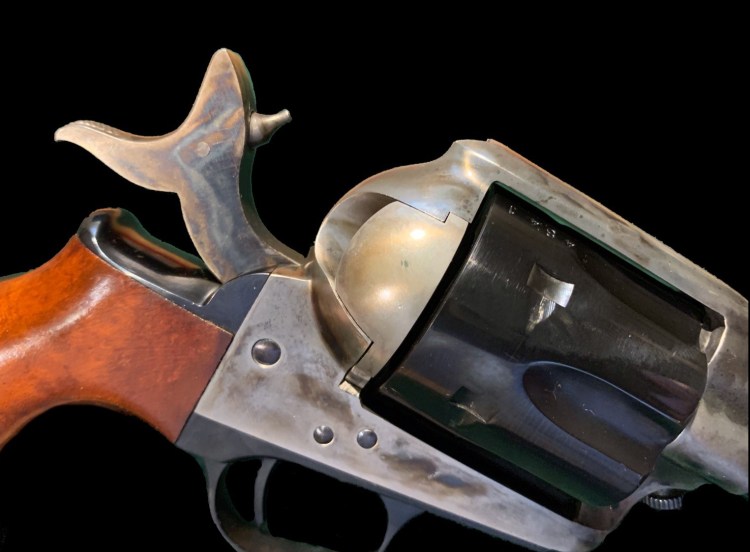
Overall, the Thunderer is a well put together, good looking firearm. The fit and finish is excellent, the features are well thought out, and the combination of a blued barrel, cylinder, and trigger guard with a color case hardened frame, and the distinctive grip, really make the handgun stand out.
Like the original Colt, the firing pin is fixed to the hammer
The action of Cimarron’s revolver remains true to the original Colt design. While other single-actions have incorporated internal firing pins, and transfer bar safety features, the Thunderer retains the firing pin affixed to the hammer. Because of this, there are still the audible three clicks as the hammer is drawn back. The first is when the hammer clears the safety position, the second is at half cock, and the third at full cock. The safety position is designed to allow the revolver to be loaded with all six rounds in the cylinder, and carried safely. However, traditionally, the hammer was in the safety position over an empty chamber in the cylinder, and the manual that comes with the Thunderer recommends this as well.
Cimarron did depart from the original Colt design, however, by incorporating another, I think unnecessary, safety feature. The Thunderer uses a “blackpowder” frame, based on early era guns. As such, the cylinder pin is retained by a screw at the front of the frame, instead of a more modern cross pin. Uberti designed the cylinder pin with additional notches along it’s length, and by loosening the retention screw, the cylinder pin can be moved back and held in place to block the hammer at half cock. But when is this safety feature useful? When storing the handgun, it would be unloaded, and wouldn’t need the hammer blocked. When the gun is loaded, at the range, moving the cylinder pin back and forth is just too cumbersome to be useful. By leaving the cylinder pin alone, however, the revolver functions just like every other Single Action Army based handgun.
Range time proved that the Thunderer is a fun gun to shoot. All testing was done standing with a one hand hold. I know, shooting this way won’t demonstrate the gun’s true mechanical accuracy. But hell, it’s a cowboy gun, and cowboy guns are shot with a one hand hold! The Thunderer isn’t for tactical use, and isn’t set up as a target pistol, so why pretend that it is? In any case, the revolver’s simple blade front sight, and notch rear sight incorporated into the top strap of the frame worked fine, and allowed reasonable accuracy.
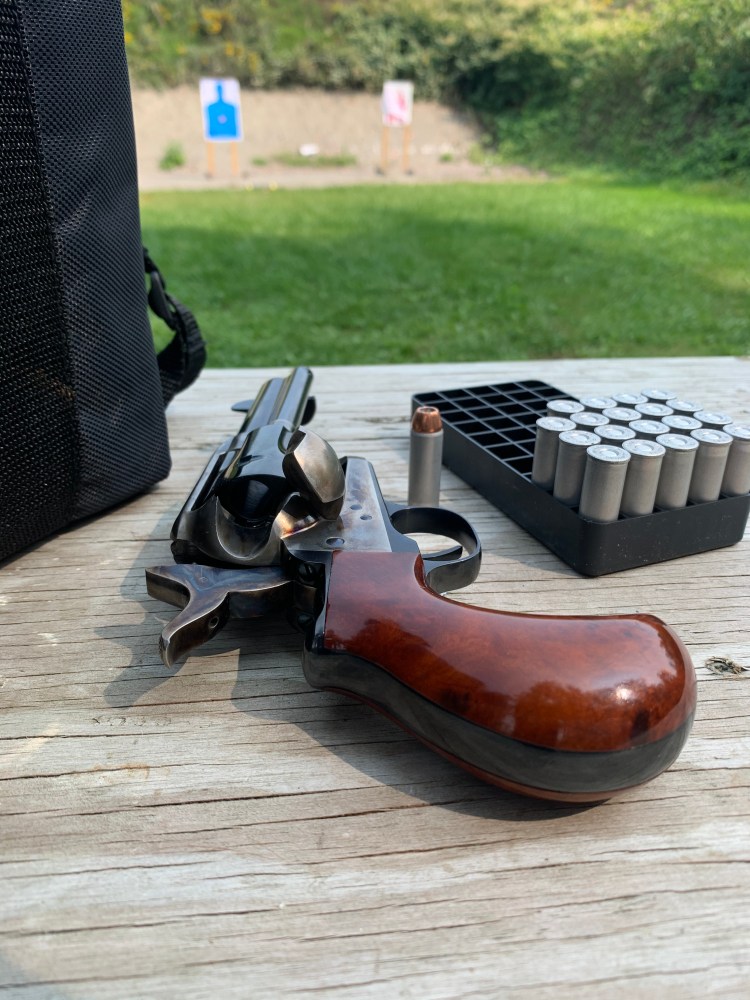
With the hammer at half-cock, the loading gate can be opened to load, or eject spent cases
Loading the Thunderer is done by placing the handgun in half-cock, and then opening the loading gate on the right side rear of the frame. Cartridges are then loaded individually into the chambers of the cylinder. Interestingly, many firearms historians believe that Sam Colt was left handed, because his design is best suited for left handed shooters. As a left hander myself, I have always appreciated this, because while my shooting hand retains positive control of the revolver, all the functions of loading and unloading can be done with my off hand. Right handers have to swap hands to load and unload, giving up positive control of the gun while doing so.
Unloading is done in the same way, placing the hammer at half cock and opening the loading gate. Then, align the chambers with the ejector rod and plunge out the spent cases individually. Again, you have to do this left handed, or the cases may hang up on your hand and not fully clear the chamber.
The Thunderer is an accurate revolver. Groups stayed tight past ten yards.
We used CCI aluminum cased jacketed hollow points for our range session. The Thunderer functioned flawlessly. All shooting was done between five and ten yards, dominant hand only. Again, for the rudimentary sights, group size was quite good. Staying with the wild west, rustic theme, group size was measured with the barrel as our measuring stick. All groups, at all ranges, stayed under the length of the barrel, so under 3.5 inches. Because of the balance of the Thunderer in the hand, even when point shooting without looking at the sights, shots stayed clustered around the intended point of impact. The Thunderer’s distinctive grip played a big part in this, because it allows the hand to stay firm while thumbing back the hammer, without needing to readjust to squeeze the trigger. Consistency allows accuracy. It also minimizes muzzle rise between shots, and while thumbing the hammer back, and also helps tame recoil.
Overall, the Thunderer is a great handgun. It has a distinctive look, it’s fun to shoot, and it really does evoke a sense of the old west. If you’re looking for a single action revolver, look no further.
Right off the bat, I’d like to say that I know it’s been some time since the last review, and thank everyone for their patience. Due to the COVID-19 outbreak, and the ensuing stay-at-home orders, it has been impossible to access ammunition and range facilities. Now, however, with ranges opening back up, and ammunition available again, more reviews are on the way. To start off, I’m reviewing what I believe to be an excellent piece of everyday gear- the tactical pen.
What makes a pen “tactical” anyway? Studies have shown that, when physical altercations occur, often there is no defensive means readily within reach. However, pens are frequently present, and in many cases already in hand. It follows that, in order to give a person an immediate means of countering a physical assault, a pen can be hardened so that it can be used effectively as a weapon without breaking. Thus, the tactical pen. And, while the tactical pen’s usefulness readily comes to mind for law enforcement, it’s applicable for many others. Imagine you’re a delivery person who needs to get a signature or collect cash. Suddenly, you’re confronted by an irrational actor who’s bigger than you, who either tries to grab you or throw a punch. As a delivery person, you don’t carry weapons, or the array of defensive devices available to law enforcement. But, you do carry a pen. If that pen is hardened, it gives you a means of countering the assault, creating distance to escape, so that you can get away and call 911.
A tactical pen can be used as an effective impact weapon
I previously used a Smith & Wesson M&P tactical pen, and found it to have some shortcomings. First, it was big, so that it drew attention to itself. It looked more like a pointed kubotan than a pen. A tactical pen should be unobtrusive- it should just look like a pen. Second, the anodized green finish bled through clothing when it got wet. I often work in the rain, and the anodizing ruined a good uniform shirt, and uniform shirts aren’t cheap. Also, the part of the barrel of the pen that unscrewed in order to replace the ink cartridge kept loosening, so that I had to tighten it down at least once a day. Last, the cap was a friction fit. That’s why I ultimately lost the pen- the cap came off in my pocket, and the pen fell out. A pen’s no good if it’s not there, and at $35, I didn’t like losing an expensive pen.
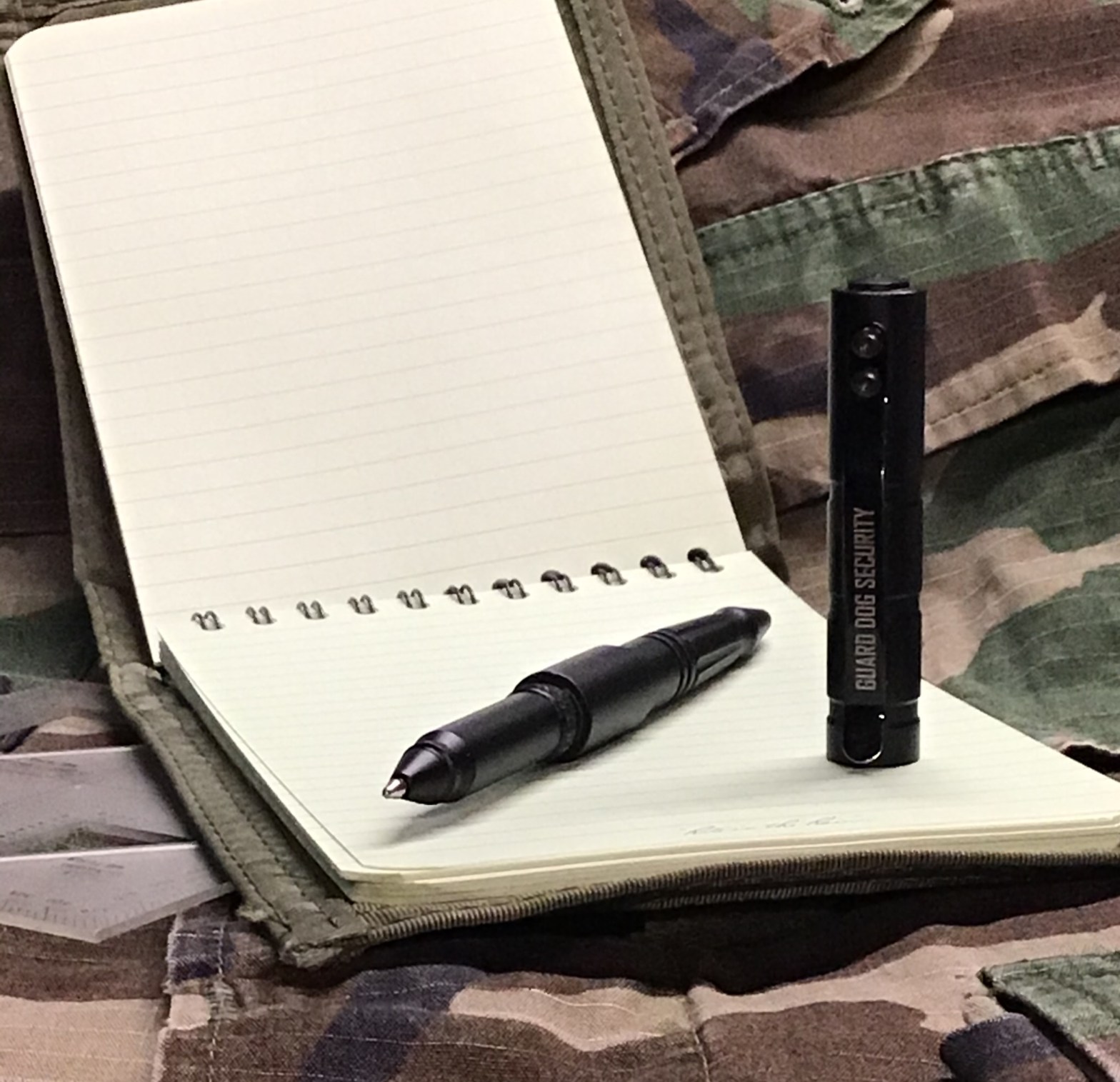
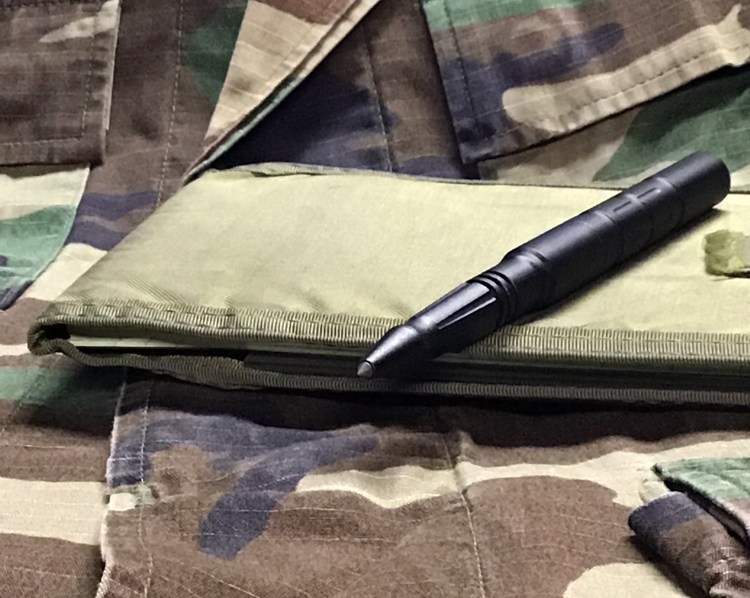
Enter the Guard Dog Security tactical pen. I’ve been using it for some time now, and I like it a lot. The pen is made of aluminum, and has a substantial feel to it. But, it also has the feel in the hand of a normal pen. The cap is a screw on type, with a strong clip that keeps it secure in shirt pockets. With the cap on, it looks like a standard push button pen. When you take the cap off, it fits firmly over the back of the pen, and the pen retains the look of a standard pen. Both ends of the body of the pen taper to a point so it can be used as an impact weapon no matter how it’s being held. The finish on the pen is matte black anodizing, and it does not run when wet. The pen also uses standard ink pen refills, that can be found pretty much anywhere.
The pen has a hardened tip that can be used to break tempered glass, and also as a stylus
There’s an additional feature on the pen that I have found to be very useful. The point of the pen opposite the writing tip has a tungsten insert. This can be used in an emergency to break tempered glass. Now, while the need to break out of a vehicle in an emergency may be slight, the feature has another use. I have found that the tip is great as a stylus for touch screen devices, if you use these kind of devices for signature capture or other business functions.
All in all, the Guard Dog Security tactical pen is a great pen. It’s a balanced writing instrument, that also has the weight and durability to be used as an impact weapon in an emergency. At a price under $15, it won’t break the bank, either.
Recently, there has been a large upswing in firearms sales, and applications for firearms licenses nationwide. I’m going to start by saying this- if you have never thought of owning a firearm, or ever trained with one, just buying a firearm as a reflex to fear doesn’t make you safe, it actually makes you a danger to yourself and others. The first step should always be learning firearms safety. Then, get hands-on training to understand what kind of firearm fits your needs. Then, purchase the firearm you have identified through learning and training. Panic buying a gun doesn’t mean you can actually safely use it, and makes gun owners look crazed to the rest of society. That will only hurt our ability to defend our Second Amendment rights in the long run.
If, however, you have done your reading, and gone through certified training, you will have noticed that there is a wide range of opinion concerning what firearms are suitable for defense of the home. Some of the opinions are sensible, and some aren’t. The way to sort out all the opinion is to first determine the essential requirements of a good home defense weapon.
First, a home defense firearm needs to be capable of safe, long term storage while loaded. All firearms need to be stored securely, either with trigger locks or in gun safes. But, for home defense, those are often too slow to access in an emergency. So, safes designed for home defense- with either a biometric or finger pad combination- are a must. Also, realize that the eventuality of having to defend your home is extremely rare, so a firearm for that purpose will likely remain stored and may never have to be actually used. That said, the firearm you choose must be capable of reliable operation any time. Be aware that many firearms use springs that are under tension when they are loaded, and that over time those springs weaken if the tension is constantly maintained.
A biometric or finger pad combination safe is a must for storing a home defense firearm
Along with this, a firearm for use in a defensive situation must be simple, but safe, to manipulate under stress. This dictates the number, and type, of safety features on the firearm. And remember, the more steps required to bring a firearm into operation, the more training is required to effectively use it.
Second, if you maintain a firearm for home defense, every adult in the home should be licensed, trained, and (extremely important) capable, of using it. This may often dictate the size, weight, and acceptable recoil of the firearm. Often, in families, the only person who considers what firearm is suitable to their needs is the primary user. But, the size, hand strength, and ability to effectively control the firearm through recoil, of all adults who may have to use it, must dictate the firearm chosen.
Third, awareness must be given to the amount of target penetration a firearm/ammunition combination is capable of. Many firearms, at the close quarters of a home defense situation, are capable of shooting through their target, and sending projectiles to continue on through the exterior walls of a typical house. You are accountable for where every shot fired ultimately lands. You must ensure that the potential for damage to unintended targets is minimal.
Last, consideration must be given to the muzzle flash a firearm generates when fired. Most often, home defense situations take place at night, in low light. If you have to fire a weapon, don’t let the muzzle flash from the first shot eliminate your night vision and impede your ability to take effective follow up shots if the situation dictates it.
Author’s pick- a .357 magnum revolver with a 6 inch barrel, loaded with .38 special+P ammo
So, having gone through the necessary requirements, what type of firearm fits the bill? Here’s what I think, and why. I think revolvers are inherently better for home defense than semi-automatic, or magazine fed weapons. The weakness of magazine fed firearms is the magazine itself. Over time, if magazines are not emptied and rotated regularly, the follower springs of the magazines will lose tension. The vast majority of semi-automatic malfunctions can be traced to magazine failures. Double feeds, failures to feed, and failures to properly eject (stovepipe malfunctions), are issues that can be caused by weak springs, and require implementing immediate action drills that eat up time and attention in an emergency situation. Revolvers have none of these issues. Stored with a loaded cylinder, no springs are under tension, and the revolver’s performance will not degrade during long term storage. Malfunctions will be reduced to possible ammunition failure, which requires the much simpler action of only pulling the trigger again to bring a fresh chamber into battery.
Often, the fact that magazine fed firearms have a higher ammunition capacity is brought up to show them superior to revolvers. But, you should ask yourself, who are you preparing to go up against. The threat you are preparing for in home defense is not some hardened breach team coming in hot, but likely one to three men looking to grab cash, jewelry, and electronics to fund a drug habit. They very likely could be armed, but they are not going to stand up to a firefight with a prepared homeowner. Also, you’re not looking to clear your home with CQB tactics, but stay in a defensible position and call 911. In short, you’re not taking the fight to the intruders, you’re keeping yourself safe and waiting for police to arrive. Using a firearm is always the last resort, and you don’t need suppressive fire for that.
As regards size and weight, there are just as many choices as for semi-automatics. You also have the advantage in home defense that you should have planned in advance to use cover like a bed or other piece of furniture to put an obstacle between you and any intruder while you wait for the police. This not only gives you an obstacle to create distance, it also gives you a rest to take up some of the weight while holding a firearm. The large number of revolver options out there ensures that you can find a grip size for any size hand. Also, the grip of a revolver is not dependent on the size of an internal magazine well, as in semi-automatics, giving revolvers much more flexibility in grip size.
For simplicity of operation, revolvers have a distinct advantage over semi-automatics. Unlike semi-autos, there are no external safeties on revolvers. This does not make them any less safe, as all the safety features are internal, ensuring that the revolver can only fire when the trigger is pulled completely. Also, in terms of hand strength, revolvers allow for double action trigger pull, which I prefer, of around 13 pounds, or single action pull, if the hammer is fully cocked, of around 3 to 4 pounds. Rotating the hammer all the way back is not difficult from a two handed grip, and allows more accurate fire for those with weaker hand strength. Care must be taken, however, when returning the hammer to the down position. But this can be accomplished after the situation has resolved, the police have arrived, and the stress has passed.
In terms of penetration, revolvers have an advantage as well, in that there are far more cast lead or semi-jacketed ammo options for revolvers. The copper jacket rounds used in semi-autos rely on very specific circumstances to deform, if they are hollow point, while cast lead hollow point ammunition is almost guaranteed to deform once it hits a target. This means that revolvers shooting cast lead projectiles have a smaller chance of over-penetration than equivalent jacketed rounds fired from semi-autos. Also, many revolvers are capable of using different ammunition. Thus you can run special loads through magnum revolvers to mitigate recoil, if necessary. I prefer to use .38 special+P ammo through my .357 magnum. The beefier frame of the magnum helps soak up recoil, while the .38 special+P still retains good terminal ballistics.
Many revolvers allow using different ammo. Here, .357 magnum and .38 special can both be run through a .357 mag
Lastly, revolvers hold another advantage over semi-autos in home defense, in that revolvers offer longer barrel lengths. Since there is no requirement for concealment, revolvers for home defense can have barrels between 5 and 6 inches in length. Almost all semi-autos top out at a 5 inch barrel. What this means, is that revolvers can give the powder more time to fully combust before the projectile leaves the muzzle, allowing less muzzle flash. Less muzzle flash gives less of a chance of dazzling your night vision in low light. This is absolutely essential as it allows you to stay in the fight should follow up shots be necessary. Going night blind just makes you vulnerable and ineffective. You need to retain all the advantages you can.
So, now that I’ve laid out what the realistic requirements of a home defense firearm are, and looked at what firearms fit those requirements, I’ll share my personal pick. I choose a Ruger Security Six revolver with a six inch barrel, chambered for .357 magnum ammunition. I run .38 special+P ammunition through it. I like Ruger, but a commensurate revolver from any manufacturer would work, as well. Depending on your circumstances, your ammo choice may vary too. But, hopefully, this has given you a place to start.
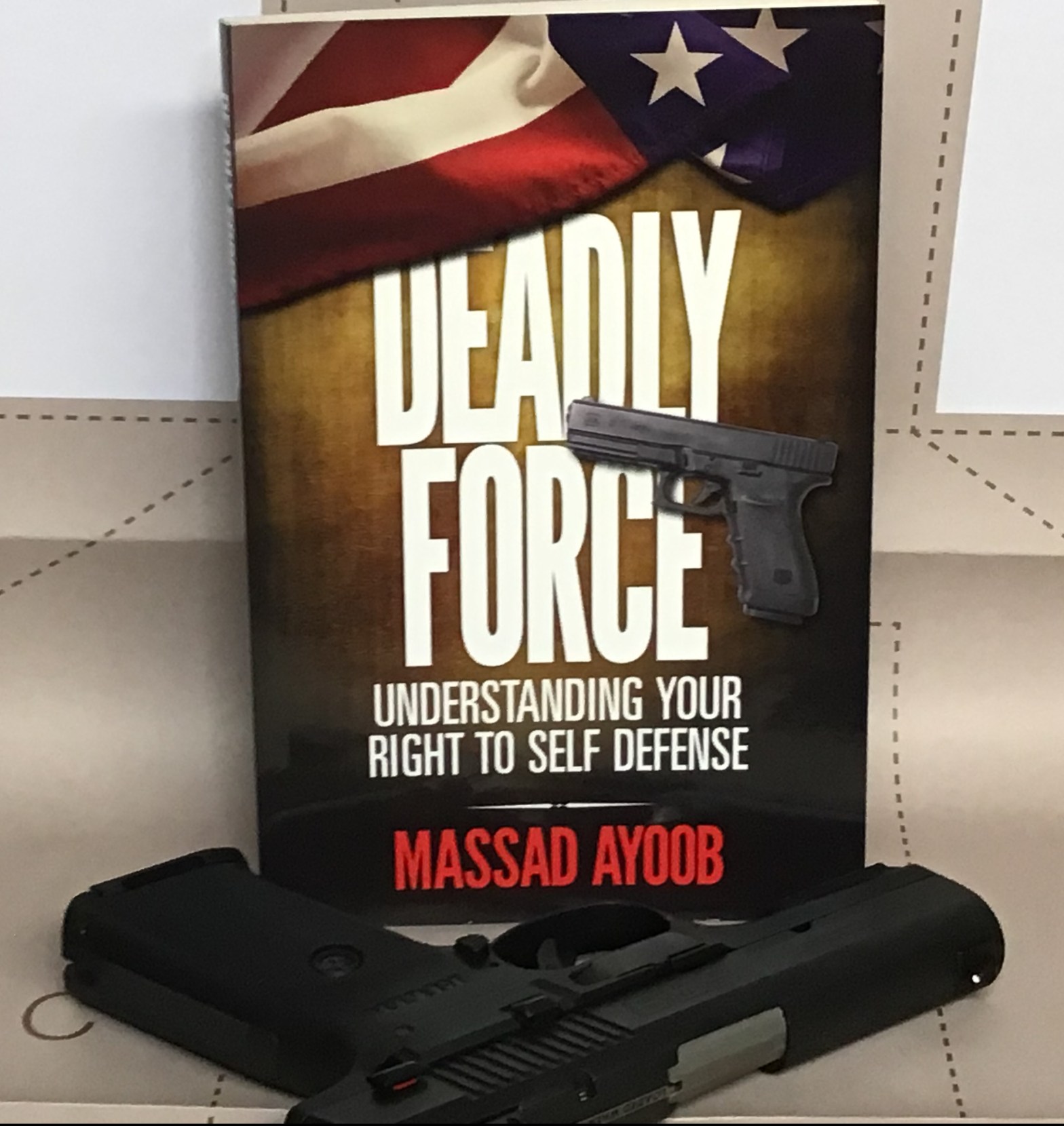
As a firearms instructor, it is amazing to me how many people who want to carry a firearm concealed have a totally unrealistic understanding of armed self-defense. There’s a whole lot more to it than just buying a pistol, a holster, and some ammo. Before you do any of that, you need to get trained, and study. The study part comes in the form of books like this one from Massad Ayoob. Ayoob is a nationally known expert on armed self-defense. Deadly Force is an update and addition to his previous book, In The Gravest Extreme (another essential read). However, Deadly Force is a stand alone book that provides detailed information about the legal realities of the use of a firearm in self-defense by civilians. It covers what kinds of situations warrant use of force, how use of force is justified, and the law enforcement and legal process that ensues after a shooting incident. Knowing this beforehand is absolutely essential for someone who wants to concealed carry. Of equal value is having a realistic understanding of the time and costs involved in the legal process after a shooting. These things are all covered in the book, along with discussions of how the firearm and ammunition you carry can effect your legal defense, and detailed case studies of actual incidents where deadly force was used in self-defense.
Despite the complex subject matter, Ayoob writes in a clear, readable style. Though it’s 237 pages, the book doesn’t take long to read. The other nice thing is, it points out other books to go to for further study. To really be prepared in case you are involved in a deadly force incident and it’s aftermath, this book is an excellent place to start. I highly recommend it to anyone seriously considering carrying a firearm for self-defense.
The Battle Arms Development Ambidextrous Selector Switch is exactly what it says: an ambidextrous switch to replace the original safety on your AR-15. I think it’s an essential upgrade to any AR. One of the biggest weaknesses of the AR-15’s design is that it is set up for right hand only operation. This is surprising, given that the two previous American service rifles were both readily usable from either shoulder. I think it reflects a very parochial attitude of the military at the time of its adoption. The late Ian Hogg, who wrote for Jane’s Publishing, summed it up when he said that soldiers simply needed to shoot right handed. This attitude, I think, dangerously overlooks the realities of modern combat in complex, most often urban, terrain.
An explanation is in order. While only seven percent of the population is left handed, making a rifle capable of ambidextrous operation is not simply about catering to a minority of shooters. Any shooter, especially one training for combat or combat athletics, should be capable of shooting ambidextrously. Why? Because negotiating angles and corners while presenting as small a silhouette as possible requires it. There are a huge number of variations in close quarters techniques, and some are better than others. Any system that doesn’t incorporate firing from either shoulder, or from both strong hand and weak hand, is neglecting a necessary tool that should be in a shooter’s toolbox. “Pieing” around corners, entering doorways from either direction, and negotiating intersecting hallways are fundamental aspects of combat shooting. They need to be accomplished while presenting as little of the shooter as a potential target as possible. That’s just not effective without being able to switch shoulders on the move. This is an area where competitive shooting has actually had a negative impact on real world training. While shooting from tip toes or on one foot around corners may work to shave time off during a practical match, it’s just not feasible in the real world.
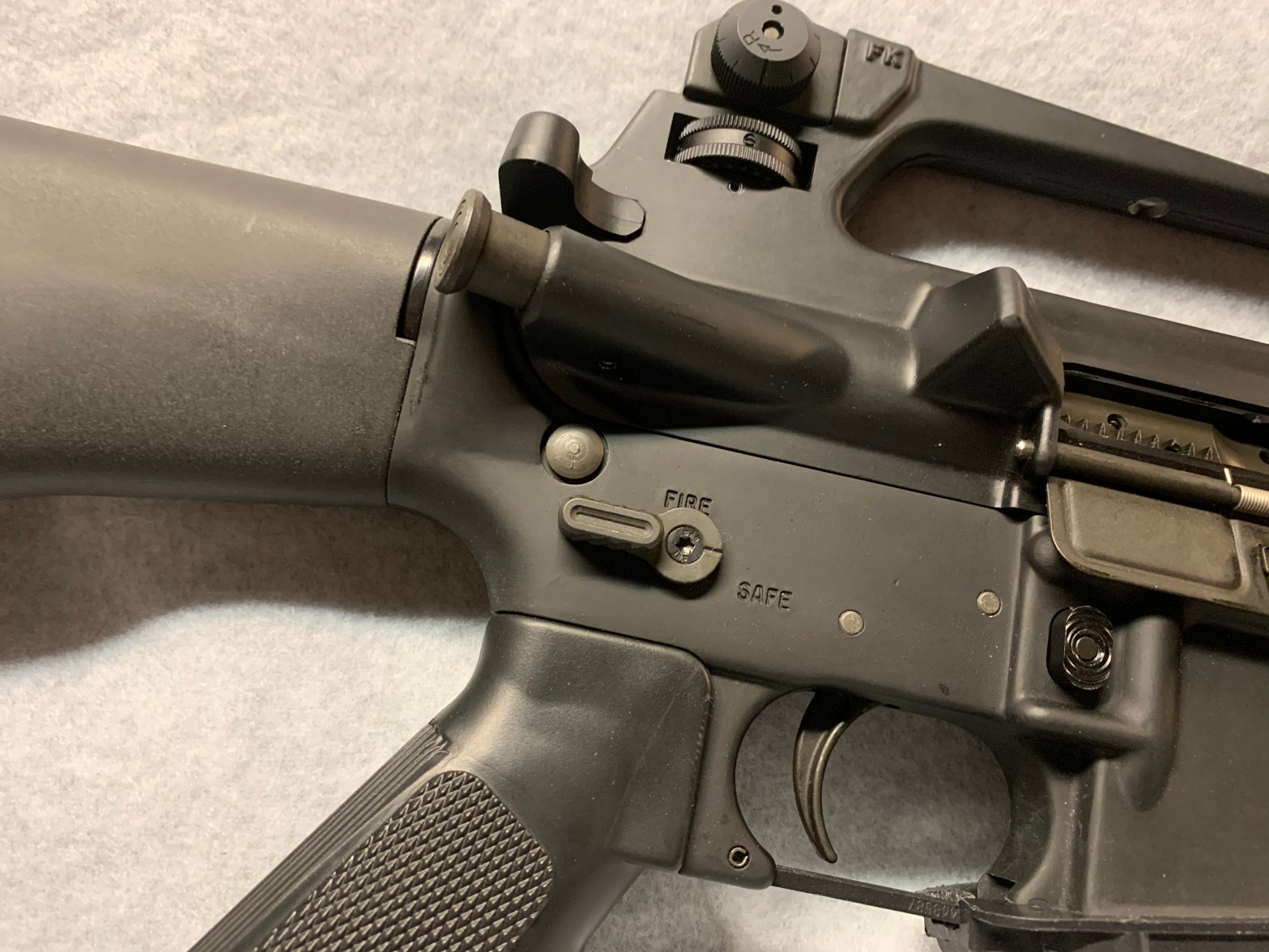
The B.A.D.A.S.S. sits in the receiver exactly like the original selector
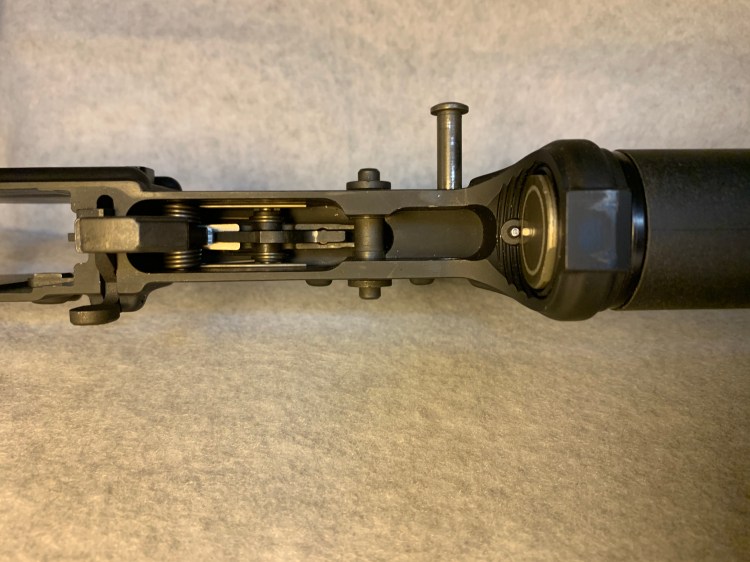
To add functionality to the AR platform, Battle Arms Development has come up with a selector switch replacement that allows effective manipulation with either hand. Any trained armored can easily install it. Simply remove the rifle’s pistol grip, the safety detent and detent spring. Then, remove the original selector through the side of the receiver. The B.A.D.A.S.S. comes with a replacement detent and spring, the body of the selector, and two selector levers of different sizes along with installation screws. Put the body of the selector into the receiver through the holes for the safety, and insert the new detent and spring. Then reattach the pistol grip. All that’s left is to install the levers themselves. The levers are different lengths, one short and one long, to differentiate between strong side and weak side. If you want, you can purchase additional levers to make both sides the same length. I like the different levers, and make the short lever the weak side lever. Installing the levers is simply putting the levers in the channels on the selector body, and installing the screws to keep them secured.
The author, left handed, uses the short lever as the weak side lever
At first, I was unsure about using screws to attach the levers, but if they are tightened to the right torque, with a little bit of blue loctite, they’re solid. I have put several hundred round through my rifle since installation, and the levers and screws are still tight.
Battle Arms Development has done a great job creating an upgrade that adds much needed functionality to the AR-15. For the $60 price tag, it should be on every AR owner’s list of essential add-ons.
















 Tactical & Target